A different centre of gravity
Architecture education has long taught students how to draw, model and communicate a design. Digital tools expanded that toolkit. AI now asks us to reconsider where we direct our teaching effort. If a student can produce an impressive image quickly, what do we actually want them to learn?
My answer is two things: how to solve problems and how to be creative. Both have always mattered in architecture. I believe they now need to become the explicit organising priorities of education, from the first design studio to doctoral research.
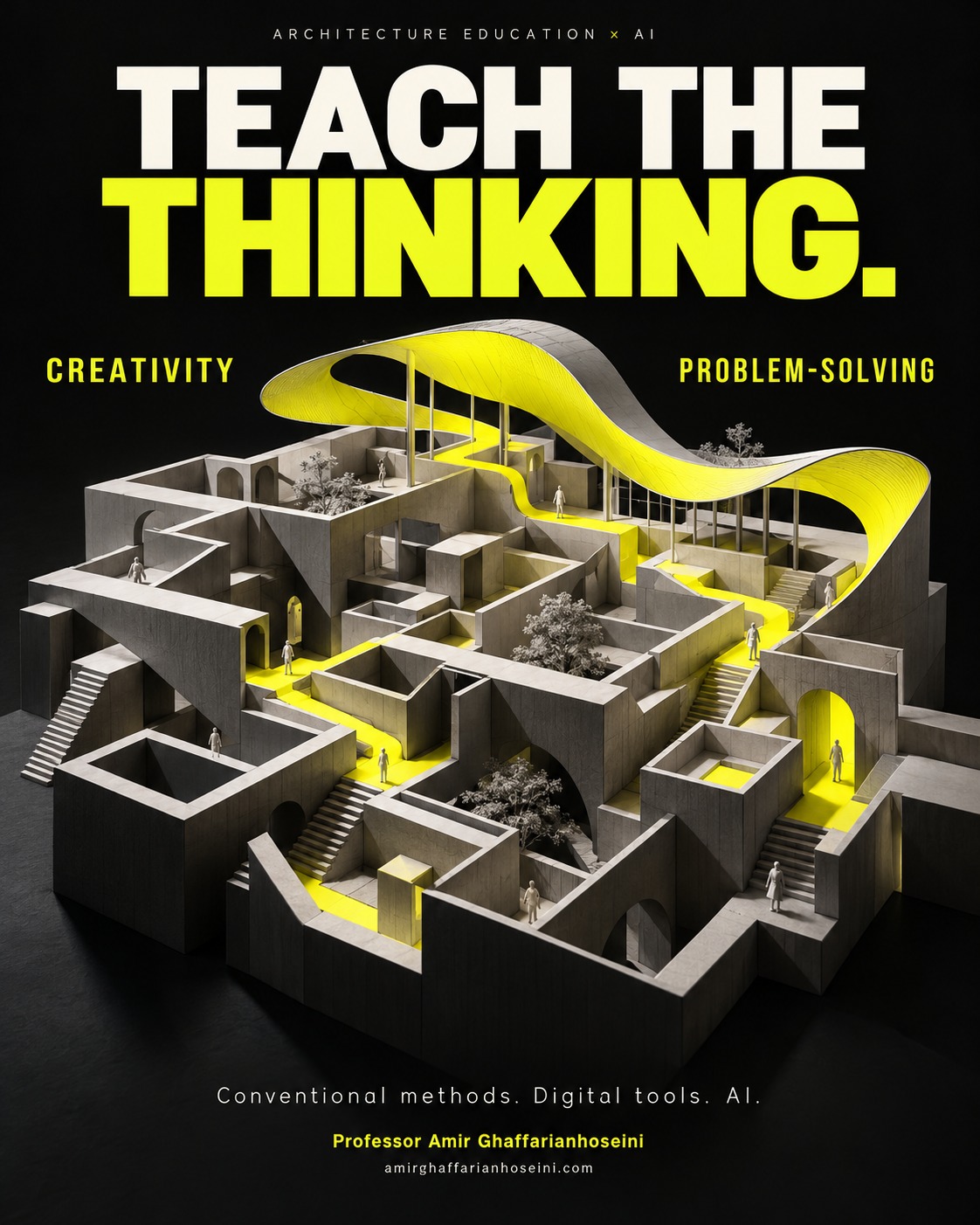
Teach the thinking behind the work
Problem-solving begins before a solution appears. Students need to recognise what matters, question a brief, understand people and context, and decide what evidence would justify a design decision. An overheating classroom, for example, is not simply a request for a new façade. It invites questions about shade, ventilation, occupancy and how learning happens inside.
Creativity needs deliberate teaching too. We can ask students to connect unfamiliar ideas, propose genuinely different alternatives and work through uncertainty. Then we can help them test and refine those possibilities. Producing more variations is useful only when students can explain what makes an alternative worth pursuing.
This shifts the emphasis of assignments. A completed drawing, model or report should make the thinking visible. We should spend less time rewarding routine task completion and more time discussing the question a student framed, the options they rejected and what changed their mind.
Choose the tools; own the judgement
Students can draw on conventional methods, digital modelling and AI to develop and communicate their work. A hand sketch may clarify an idea; simulation may test it; AI may suggest alternatives. Choosing between them should follow the learning purpose.
Architectural knowledge remains essential: materials, construction, space, climate, culture and ethics give students the means to judge an answer. Creativity and problem-solving need that grounding. We still teach practical skills, but connect each skill to a meaningful question rather than treating mastery of a tool as the destination.
AI is still developing and cannot be trusted uncritically. A convincing output can conceal errors, bias or an unbuildable proposal. Students must check claims, disclose AI assistance and remain responsible for their decisions. Sometimes the most useful exercise will require them to reason without AI.
A first-year student might explain a spatial choice; a master’s student might compare competing strategies; a doctoral researcher might challenge how a problem has been defined. The complexity changes, but the educational purpose remains: help students ask better questions, imagine possibilities and make defensible decisions. That is where I believe our teaching energy should go.
Cite this perspective
Ghaffarianhoseini, A. (2026, October 31). AI is changing architecture education. What should we teach? AG++ studio. https://amirghaffarianhoseini.com/perspective-ai-architecture-education