Architectural education has built strong traditions around drawing, making, understanding buildings and developing designs through studio practice. Digital technologies expanded that toolkit, bringing new ways to model, simulate and communicate architecture. The emergence of AI now raises a deeper question: how should we change what we teach, and what we expect students to learn?
Put creativity and problem-solving first
In my view, adding AI to an already crowded list of software skills is insufficient. We need to reconsider the educational priorities around which studios, tutorials, assignments and crits are organised.
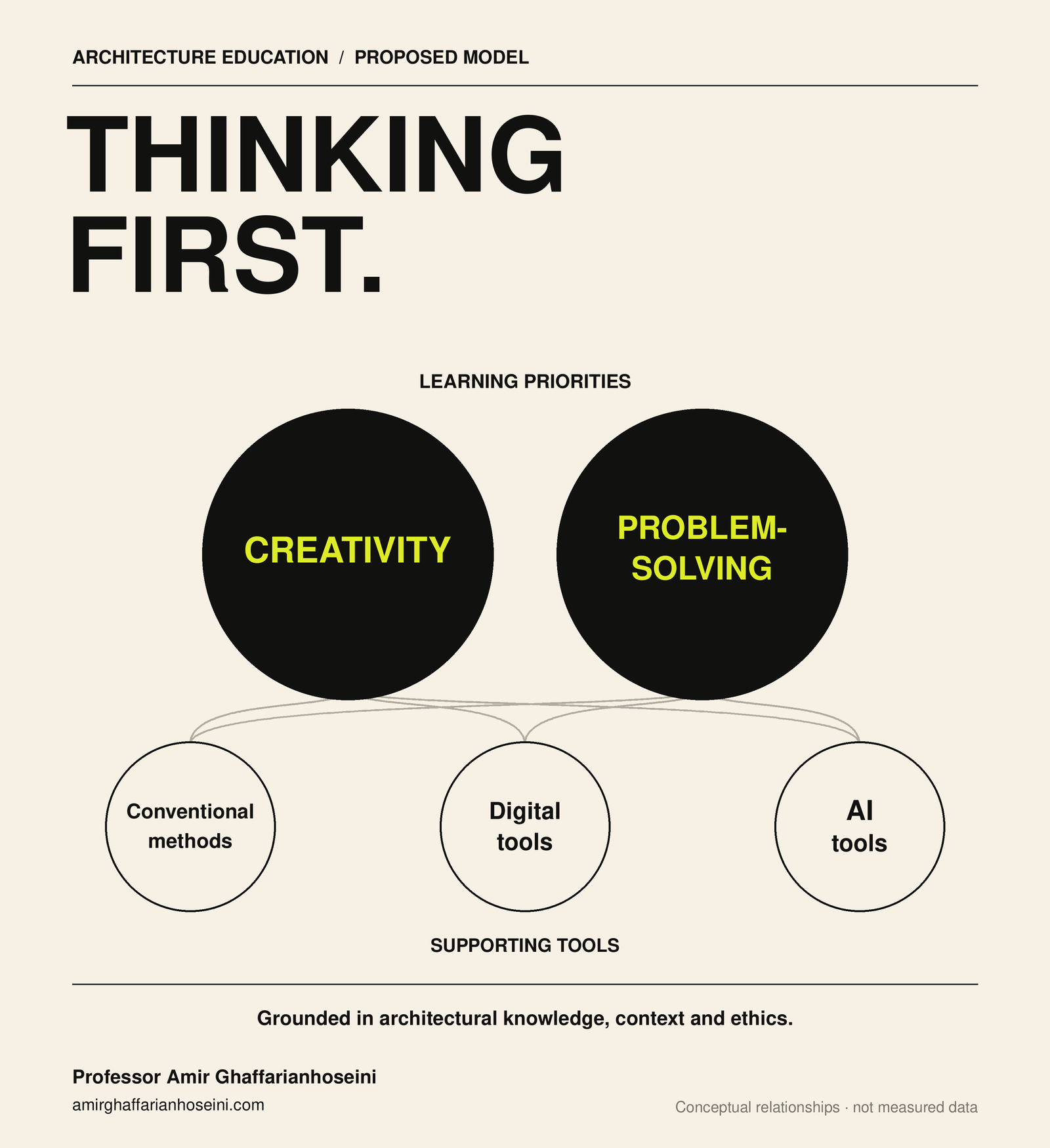
I believe two capabilities should become our primary focus: how to be creative and how to solve problems. Students should learn to use conventional methods, digital technologies and AI effectively and inventively in support of those capabilities.
Creativity and problem-solving have always belonged to architecture. My argument is that they now need to become more explicit in how we teach, what students practise and how we assess their development.
More capacity to create better places
I do not see AI as a replacement for architects. I expect it to take on a growing share of the time-consuming tasks involved in architectural work, although its capabilities and reliability will develop unevenly. This could give architects greater capacity to address more demanding questions and explore possibilities that limited time and resources might otherwise leave untouched.
That opportunity matters. We could spend more time understanding people, testing alternatives and bringing additional disciplinary perspectives into design. Health, neuroscience, climate, ecology, culture and community experience could inform decisions more deeply. The ambition should be to use this capacity to create better places.
Rethink studios, tutorials and crits
For education, this means making the purpose of learning clearer. Completing a drawing, model or presentation remains useful, but the completed task should reveal something more important: how a student understands a situation, develops an idea and judges whether it is worth pursuing.
Studios should therefore give students room to define and reconsider problems. Tutorials should help them investigate alternatives and select appropriate methods. Crits should examine how they reached a decision, what they tested, what they rejected and what changed through the process.
Assessment should recognise that thinking. Students could show their initial interpretation, explain how they used AI or other tools, identify weaknesses in the results and demonstrate how their own judgement shaped the final design. Sometimes, working without AI will be essential to developing that judgement.
Knowledge and judgement remain fundamental
Architectural knowledge remains fundamental. Students need to understand space, materials, construction, environmental performance, culture and ethics to evaluate what any tool produces. A convincing image can still describe an impractical building or overlook the people who will use it.
As AI develops, our opportunity is to prepare architects who can imagine more, investigate more deeply and make better decisions about the places we create.
These are my personal views. They do not represent the views or policies of the School of Future Environments or Auckland University of Technology (AUT).
Keywords: Architectural education · Artificial intelligence · Creativity · Problem-solving · Design studios
Share this perspective
Cite this perspective
Ghaffarianhoseini, A. (2026, October 31). AI is changing architecture. Our teaching needs to change too. Perspectives series: Ideas for better buildings and cities, pp. 1–3. https://amirghaffarianhoseini.com/perspective-ai-architecture-education